
Disclosure: TopAINest is reader-supported. This post contains affiliate links, and we may earn a small commission if you buy through them — at no extra cost to you. We only recommend products we’d genuinely tell a friend to buy.
Walk onto a modern factory floor in 2026 and you’re stepping into something that would have seemed like science fiction a decade ago. Collaborative robots work alongside human employees, sensors on every machine stream live data to AI models, and algorithms quietly prevent equipment failures before they knock production offline. Manufacturing — once stereotyped as slow to change — has become one of the most aggressive adopters of artificial intelligence in the global economy.
The numbers are striking. McKinsey estimates that AI-driven automation in manufacturing could generate between $1.7 trillion and $3.7 trillion in global value by 2030 — and that wave is well underway. German automakers, South Korean electronics firms, North American aerospace companies, and food processors are all racing to deploy AI at scale. The question is no longer whether AI will transform manufacturing; it’s whether any given company is moving fast enough to stay competitive.
Here’s what’s actually happening on factory floors right now — broken down by the technologies making the biggest difference.
The Robot Revolution on the Factory Floor
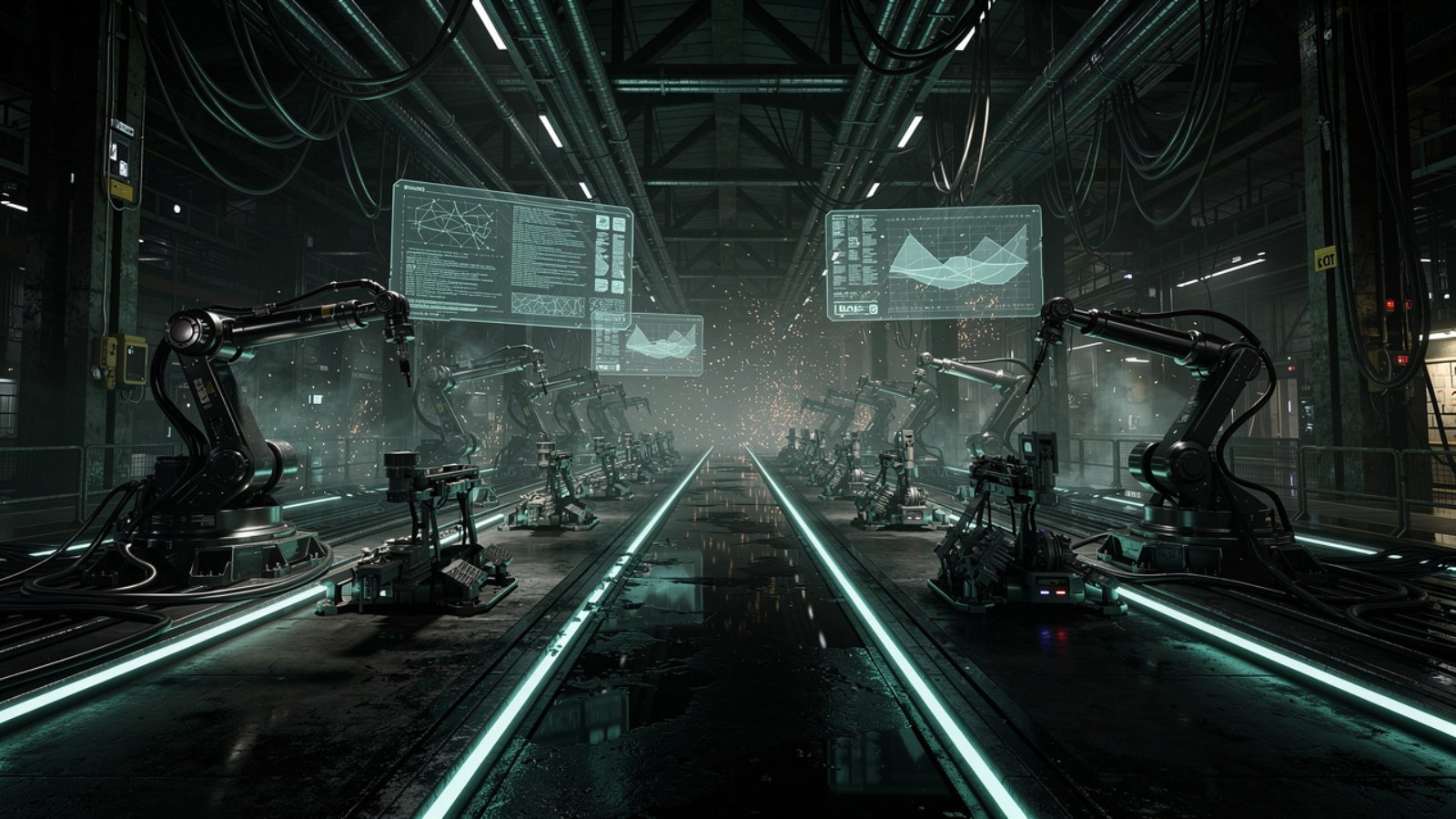
Industrial robots aren’t new — they’ve been welding car frames since the 1970s. What is new is intelligence. Modern collaborative robots (cobots) use computer vision and real-time learning to work safely beside humans, adjusting their movements based on what’s happening around them rather than following a rigid pre-programmed path. They can sense when a human hand enters their workspace and slow or stop automatically. The safety cage that used to separate humans from robots is, in many applications, gone.
In 2026, companies like Universal Robots, ABB, and Fanuc are deploying AI-native arms that can be taught a new task in minutes — a line worker physically guides the arm through a motion, and the AI learns it. No robotics engineer required. Tesla’s Gigafactories use fleets of autonomous mobile robots (AMRs) that navigate the floor using LiDAR and AI planning algorithms, rerouting themselves around obstacles and workers in real time. NVIDIA’s Omniverse platform lets manufacturers simulate entire robotic workflows in a virtual environment before a single physical robot is purchased.
For smaller manufacturers, the barrier to entry has dropped sharply. Cloud-based AI vision systems can now be retrofitted to legacy machinery for a few thousand dollars, turning a decade-old CNC machine into one that can detect tool wear and self-correct cutting parameters. This democratisation of robotics is reshaping not just automotive and electronics, but pharmaceuticals, food processing, and custom furniture manufacturing.
Predictive Maintenance: Stopping Breakdowns Before They Happen
Unplanned downtime costs manufacturers an estimated $50 billion a year in North America alone. Traditional maintenance was either reactive — fix it when it breaks — or scheduled — replace parts on a calendar, even if they’re still in perfect condition. AI-powered predictive maintenance is changing the math entirely.
The approach works by wiring machines with vibration sensors, thermal cameras, and acoustic monitors, then feeding that continuous stream into AI models trained to recognise the subtle signatures that precede failure. A bearing about to seize vibrates at a slightly different frequency days before it fails. A hydraulic pump heading for trouble runs a fraction of a degree hotter than its baseline. A motor drawing marginally more current than normal might have a developing fault in its windings. AI catches all of this; maintenance teams catch it before it becomes a crisis.
Siemens, Honeywell, and GE are running predictive maintenance programmes across thousands of industrial assets globally. Real-world deployments consistently show 20–40% reductions in maintenance costs and unplanned downtime cut by as much as 50%. For capital-intensive industries like steel, chemicals, and aerospace manufacturing, those percentages translate to hundreds of millions of dollars saved annually. An oil refinery that avoids a single unplanned shutdown can save more than the entire annual cost of its AI programme in one event.
Smart Factories and the Industrial Internet of Things
A “smart factory” — the centrepiece of Industry 4.0 — is a facility where every machine, sensor, conveyor, and system is connected and shares data in real time. The Industrial Internet of Things (IIoT) provides the nervous system; AI provides the brain that interprets it all and drives decisions.
In practice, the most powerful application is the digital twin: a live virtual replica of the physical factory that runs continuously alongside the real one. Engineers can test a process change in the digital twin — say, speeding up one production stage or substituting a component material — before applying it to the actual line, eliminating the expensive trial-and-error that used to be the only option. Bosch’s flagship factory in Reutlingen, Germany has been running a comprehensive digital twin since 2023, and reports a 25% improvement in overall equipment effectiveness since implementation.
Smart factory AI also optimises energy consumption, shifting heavy-load processes to off-peak hours automatically and trimming electricity costs by 10–15%. In a manufacturing environment running twenty-four hours a day, that’s a meaningful bottom-line impact — and as energy prices remain elevated in 2026, it’s becoming a genuine competitive differentiator.
AI-Powered Quality Control: Defects Caught in Milliseconds
Human quality inspectors are skilled and experienced. AI vision systems are faster, more consistent, and don’t fatigue at hour seven of a twelve-hour shift. That’s not a case against human inspectors — it’s a case for deploying both in complementary roles.
Computer vision models trained on thousands of images of defective and acceptable products can flag problems at line speed — inspecting hundreds of units per minute with error rates well below human benchmarks. Foxconn uses AI visual inspection across its electronics assembly lines in Taiwan and mainland China, catching surface defects measured in fractions of a millimetre. BMW deploys AI cameras that inspect spot welds in real time and automatically pause the production line when a deviation exceeds tolerance, preventing a defective subassembly from advancing to the next stage.
Beyond catching defects in the moment, AI quality systems generate structured data. Every rejection is logged with an image, a timestamp, and the associated production parameters, creating an audit trail that helps process engineers trace a cluster of defects back to a specific material batch, a shift changeover, or a gradual machine drift — information that used to take days of manual investigation to surface. That data also feeds back into the AI, continuously improving its detection accuracy.
The Human Side of AI in Manufacturing
It would be dishonest to write about AI in manufacturing without addressing the workforce question directly. Automation has already restructured manufacturing employment significantly over the past two decades, and AI accelerates that restructuring. Oxford Economics has estimated that 20 million manufacturing jobs globally could be displaced by robots and AI by 2030 — a figure that demands a serious response, not reassurance.
The honest picture is more complicated than simple subtraction, though. Many displaced roles are being replaced by different roles: maintenance technicians for AI systems, data analysts for sensor networks, robot trainers, process engineers who work with digital twins, and quality specialists who interpret AI-flagged exceptions rather than performing manual inspection. Germany’s industrial sector, which has invested heavily in automation for decades, maintained lower manufacturing unemployment in 2025 than it did in 2015. The transition is genuinely disruptive, but it isn’t only subtractive.
The most forward-looking manufacturers are investing in reskilling alongside their automation programmes. Siemens runs a global initiative to retrain production workers as “technology coaches” who can program and maintain the cobots working beside them. It’s not painless — not every worker wants or can make that transition — but it’s a more honest model than pretending automation doesn’t fundamentally change what factory work looks like. The companies that handle this transition well will have a workforce advantage; the ones that don’t will face higher turnover, skills gaps, and community friction.
Further Reading
If you want to go deeper on AI and the factory of the future, these books are worth your time:
- Industry 4.0: Managing the Digital Transformation — a rigorous overview of how AI, IoT, and robotics are reshaping global production systems. See on Amazon → ~$35
- The AI Advantage by Thomas H. Davenport — practical frameworks for deploying AI in industrial and enterprise settings, with case studies across sectors. See on Amazon → ~$28
- Smart Manufacturing: The Lean Six Sigma Way — bridges traditional lean manufacturing and modern AI-driven process improvement for operations professionals. See on Amazon → ~$42
How is AI affecting manufacturing jobs?
AI is automating repetitive and hazardous tasks while creating new roles for AI trainers, robot technicians and data analysts. Most manufacturers report workforce redeployment rather than mass layoffs — workers shift toward oversight, quality review and creative problem-solving. For a broader look at AI in other industries, see our guide on how AI is transforming agriculture in 2026.
What is predictive maintenance and how does AI power it?
Predictive maintenance uses AI-driven sensors and machine learning models to monitor equipment in real time, detecting subtle signs of wear before a breakdown occurs. Unlike scheduled maintenance (which replaces parts on a fixed calendar), predictive systems act only when data indicates an actual risk — reducing unplanned downtime by up to 50% and extending equipment lifespan.
Which manufacturing sectors are adopting AI the fastest?
Automotive, electronics, pharmaceuticals and food processing lead adoption, driven by precision requirements and high production volumes. Companies like Tesla, BMW and Samsung are deploying AI quality control and collaborative robots at scale, and the trend is accelerating as AI hardware costs continue to fall.
The Bottom Line
AI is changing manufacturing faster and more completely than most people outside the industry realise. The tools — predictive maintenance, computer vision quality control, collaborative robots, digital twins, IIoT energy optimisation — are well past the pilot stage and delivering measurable, significant results at manufacturers that have committed to deploying them seriously.
The challenge for 2026 and beyond isn’t whether the technology works. It’s whether manufacturers can bring their workforces, supply chains, and leadership cultures along for the ride at the pace the technology is moving. The factories winning right now are the ones treating AI as a tool that makes human expertise more effective, not a replacement for it. That framing may not hold indefinitely as automation deepens — but it’s the honest description of where we are today, and a sound guide to how manufacturers should be thinking about these investments.


Leave a Reply