Disclosure: TopAINest is reader-supported. This post contains affiliate links, and we may earn a small commission if you buy through them — at no extra cost to you. We only recommend products we’d genuinely tell a friend to buy.
Humanoid robots are no longer science fiction. By mid-2026, companies like Tesla, Figure AI, Boston Dynamics, and Agility Robotics have machines working alongside humans in real factories, warehouses, and research facilities. The question has shifted from “will robots look like us?” to something more urgent: which industries get disrupted first, and how fast?
The answer depends on a mix of factors — how structured the work environment is, how much labour turnover costs, whether safety requirements favour robots, and how quickly a business can expect a return on hardware investment. Some industries are sitting right at the edge. Others are years away from meaningful impact.
Here’s a clear-eyed breakdown of which sectors face the earliest disruption and why — grounded in what’s already being deployed, not just what’s been announced at trade shows.
Why Humanoid Robots Are Arriving Faster Than Expected
A few years ago, industry analysts expected humanoid robotics to remain a niche research topic through the late 2020s. That timeline has collapsed. Three forces are driving faster adoption than almost anyone anticipated.
First, hardware has gotten dramatically cheaper. The cost of servo motors, sensors, and onboard AI chips dropped sharply as electric vehicle battery technology — which shares many manufacturing processes — scaled globally. Tesla’s supply chain for Optimus directly benefits from the same production lines that build the Model Y, giving it a cost structure no pure-play robotics startup can match today.
Second, foundation models changed what’s possible. Modern robots don’t need every motion explicitly programmed — they learn by watching video demonstrations and improve through operational feedback. Figure AI’s partnership with OpenAI is the clearest public example: the company trained its robot on human video data to handle novel warehouse tasks it was never explicitly scripted for, cutting development time dramatically.
Third, labour economics shifted the urgency. Warehouses and manufacturing plants in North America face structural worker shortages, with turnover in some roles running above 100% annually. Robots don’t quit, don’t need benefits, and can run three shifts without fatigue. For CFOs staring at those numbers, a six-figure robot that lasts five or more years is a compelling line item on a spreadsheet.
Manufacturing and Warehousing — The First Dominoes to Fall
If you want to see where humanoid disruption starts, look at the factory floor and the fulfilment centre. The environment is structured, the tasks are repetitive, and the results are measurable — exactly what today’s robots handle best.
BMW’s Spartanburg plant in South Carolina has been running Figure 01 units in a supervised trial, handling parts transfer and assembly-assist tasks since late 2025. The robots aren’t replacing entire production lines — they’re plugging gaps that existing fixed automation can’t reach because the tasks change too often or the physical space is too irregular. Amazon is running parallel trials with Agility Robotics’ Digit units in fulfilment centres, focused on tote-moving and shelf-replenishment tasks.
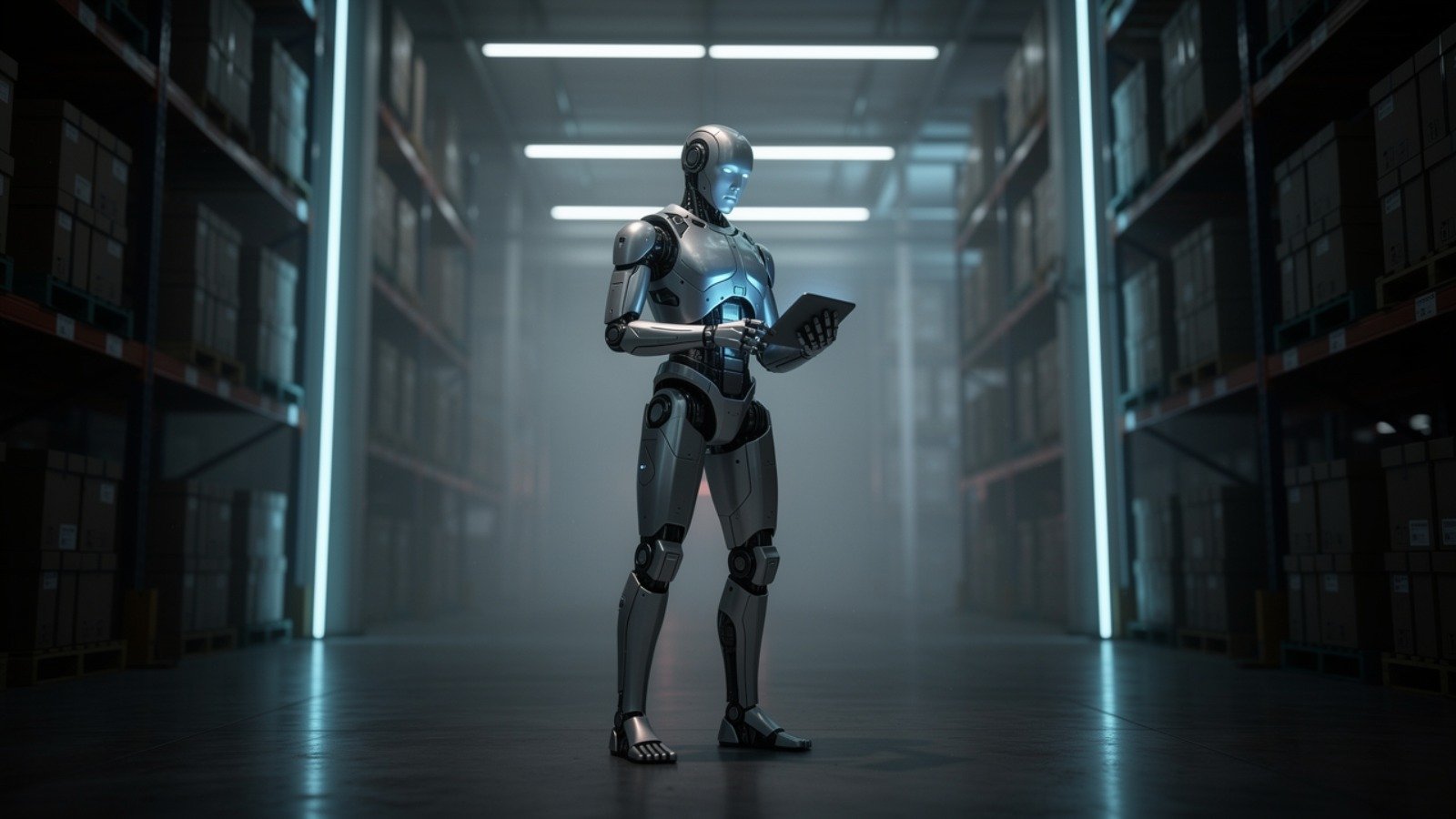
Warehousing is particularly ripe because the work is already modular: pick, pack, move, repeat. A humanoid robot can navigate the same aisles a human worker walks, use the same shelving systems already installed, and integrate with existing warehouse management software with relatively minor changes. You don’t have to redesign the facility — that’s a meaningful advantage over traditional fixed automation, which typically requires a purpose-built environment.
Realistic timeline: meaningful displacement in repetitive warehouse and light-manufacturing roles is likely within the 2028–2030 window, as robot costs fall and current commercial trials mature into scaled deployments.
Healthcare and Elder Care — The Demographic Argument
Healthcare is a nuanced case. The work is physically demanding — patient transfers, mobility assistance, supply transport between wards — but it also requires judgment and genuine compassion that robots can’t replicate in 2026. The realistic near-term role for humanoid robots in healthcare isn’t diagnosing patients or providing emotional support. It’s the logistics and the physical labour that currently injures workers and drives burnout.
Japan is the clearest signal. With one of the world’s oldest populations and a shrinking pool of younger caregivers, Japan has funded healthcare robotics since the 2010s. There is now serious policy momentum to deploy humanoid robots for tasks like helping residents transfer from bed to wheelchair and delivering meals within care facilities — work that causes significant back injuries in human staff and contributes to unsustainable turnover rates.
In hospital settings, the case is clearest for robot couriers — moving medication, lab samples, and linen between departments. These robots can use existing hospital infrastructure (elevators with standard button panels, corridors built for human dimensions) without expensive facility retrofits. Several US and European hospital systems are running active trials in 2026.
Retail, Hospitality and Food Service
Retail is harder than it looks on the surface. Yes, shelf-stocking and inventory counting are repetitive and measurable. But consumer retail stores are chaotic — spills, misplaced products, unpredictable customer movements, variable lighting — in ways that a controlled warehouse isn’t. That chaos is genuinely difficult for today’s robot perception systems to navigate reliably.
The more achievable early deployment in retail is back-of-house: stock rooms, loading dock operations, and overnight restocking in large-format stores where robots can work in a lower-traffic, more structured environment. Customer-facing retail robots navigating a busy grocery store at peak hours are realistically five to eight years out for widespread adoption.
Food service follows a similar pattern. Fast-food kitchens are being automated with fixed task-specific machines — Miso Robotics’ Flippy for frying, automated drink dispensers — not general-purpose humanoids. Hospitality — cleaning hotel rooms, delivering room service, carrying luggage — is a more achievable near-term use case because those tasks are lower-speed and lower-precision, and the ROI math works in large hotel operations already struggling with housekeeping staffing.
Construction and High-Risk Environments
Construction is theoretically one of the most attractive targets — physically demanding, genuinely dangerous, and facing serious labour shortages in most developed markets. The problem is that construction sites are among the least structured environments imaginable. Every site is unique, conditions change daily, and tasks require real-time judgment about irregular surfaces, dynamic hazards, and improvised problem-solving that current AI cannot handle reliably.
The robots reaching construction sites soonest are task-specific rather than general-purpose: bricklaying robots like SAM100 (already commercially deployed), rebar-tying robots, and site inspection drones. Humanoid robots could eventually handle material movement on sites, but fully autonomous participation in general construction is probably beyond the 2030 horizon for most applications.
Nuclear decommissioning and other hazardous environments are the meaningful exception. Cost tolerance is much higher here, environments are more structured than a typical building site, and the alternative — human workers in dangerous conditions — carries serious safety and liability risk. Government programmes in Japan, France, and the US are actively funding humanoid robotics for these niche but important applications today.
What Makes an Industry Ready for Humanoid Robots?
Stepping back, the sectors closest to disruption share a few consistent traits. They have structured, repeatable physical tasks that can be broken into predictable steps. They face high labour turnover or genuine difficulty filling positions, which sharpens the business case for capital investment. Their physical environments are (or can readily be made) relatively controlled and consistent. And they can tolerate robots that operate at 70–80% of human pace — a meaningful performance gap that still pays off when the robot works 24 hours a day and never calls in sick.
Industries that score poorly on these traits — creative and knowledge work, skilled trades requiring constant improvisation, customer-facing roles that demand genuine emotional intelligence — face much slower disruption, whatever the headlines suggest. The technology is improving rapidly, but it is improving from a starting point that is still far behind what a reasonably trained human can do in an unstructured environment.
Further Reading
If you want to go deeper on where robotics is headed and how economists think about labour displacement, these books are worth your time:
The Technology Trap by Carl Benedikt Frey traces how past waves of automation disrupted labour markets — and why the transition is rarely as smooth as optimists predict. Essential context for thinking about humanoid robots today. See on Amazon → (~$25)
Power and Progress by Daron Acemoglu and Simon Johnson examines who actually benefits when new technology deploys at scale — a useful and often uncomfortable counterweight to uncritical tech optimism. See on Amazon → (~$28)
The Coming Wave by Mustafa Suleyman (co-founder of DeepMind) covers AI and robotics together, with an unusually honest account of the risks alongside the opportunities. One of the most readable takes on where this technology is actually headed. See on Amazon → (~$22)
Frequently Asked Questions
The Bottom Line
Humanoid robots will not disrupt all industries equally or at the same pace. The clearest near-term targets are manufacturing, warehousing, and healthcare logistics — sectors where the work is structured, the economics are measurable, and the business incentive to automate is already strong. Retail, hospitality, and food service will follow as the technology matures. Construction and truly unstructured environments are further out still.
If you work in one of the early-disruption sectors, this is worth paying attention to now — not to panic, but to understand what is actually being deployed versus what is still vaporware. The gap between the two is smaller than it was two years ago, and it is closing faster than most people realise.