
Disclosure: TopAINest is reader-supported. This post contains affiliate links, and we may earn a small commission if you buy through them — at no extra cost to you. We only recommend products we’d genuinely tell a friend to buy.
In January 2025, OpenAI, SoftBank, and Oracle stood alongside President Trump at the White House to announce Project Stargate — a joint venture promising to invest up to $500 billion in AI infrastructure across the United States over four years. It was the kind of announcement that made even seasoned tech observers pause. Half a trillion dollars. For data centers.
Since then, the project has evolved, attracted additional partners, broken ground on its first campuses, and generated a fair amount of controversy. If you’ve seen the name in AI headlines and wondered what exactly is being built — and why it matters — this guide breaks it down in plain language.
Project Stargate is not just a single data center or a funding round. It is the largest private infrastructure investment in AI history, and it is betting that whoever controls the most powerful computing clusters will largely shape what artificial intelligence looks like in the next decade.
In this guide
What Is Project Stargate?
Project Stargate is a joint venture created to build artificial intelligence infrastructure — primarily massive data centers packed with GPUs and specialised AI chips — across the United States. The name refers to the initiative as a whole, not a single facility. It is an umbrella project for what the founders describe as the physical foundation that future AI systems will require to operate at scale.
The core insight driving it is simple: training and running frontier AI models — the kind powering ChatGPT, advanced medical research tools, and autonomous systems — requires enormous amounts of computing power. Today’s data centers were not built with that demand in mind. Project Stargate aims to build the ones that are.
The first Stargate campus broke ground in Abilene, Texas, in early 2025. As of late 2026, construction is underway at multiple US sites, with Texas serving as the main hub. The project envisions up to 20 data center campuses in the US, with potential international expansion in later phases. Each campus is designed not as a single building but as a sprawling multi-building complex, some covering hundreds of acres.
Who Is Behind It and How Much Are They Spending?
The founding partners of Project Stargate are OpenAI, SoftBank, and Oracle. SoftBank committed to serving as the primary financial backer, with CEO Masayoshi Son taking the lead investor role. OpenAI provides the AI expertise and uses the infrastructure for its own model development. Oracle is handling a significant share of the data center construction and ongoing management.
Microsoft, which has been OpenAI’s largest investor since 2019 and provides cloud capacity through Azure, is not a founding partner of the Stargate JV — a detail that attracted notice when the project was announced. Microsoft has clarified that its own multi-billion-dollar AI infrastructure buildout continues independently, and the two relationships are complementary rather than competing. In practice, OpenAI continues to use both Microsoft Azure and the new Stargate facilities.
Other companies have joined as technology partners, meaning they supply components and expertise rather than capital. These include NVIDIA, Arm, and Oracle’s infrastructure subsidiary. NVIDIA’s role is particularly central: Stargate data centers are built around clusters of NVIDIA’s most advanced chips, including the Blackwell architecture GPU family announced in 2024 and its successors.
The $500 billion figure is the total investment target over four years. The first phase committed an initial $100 billion from SoftBank. Whether the full amount materialises depends on fundraising momentum, AI demand growth, and the pace at which the infrastructure generates returns. Even at half the stated target, the project would represent a historically unprecedented injection into US computing infrastructure.
What Will the Infrastructure Actually Look Like?
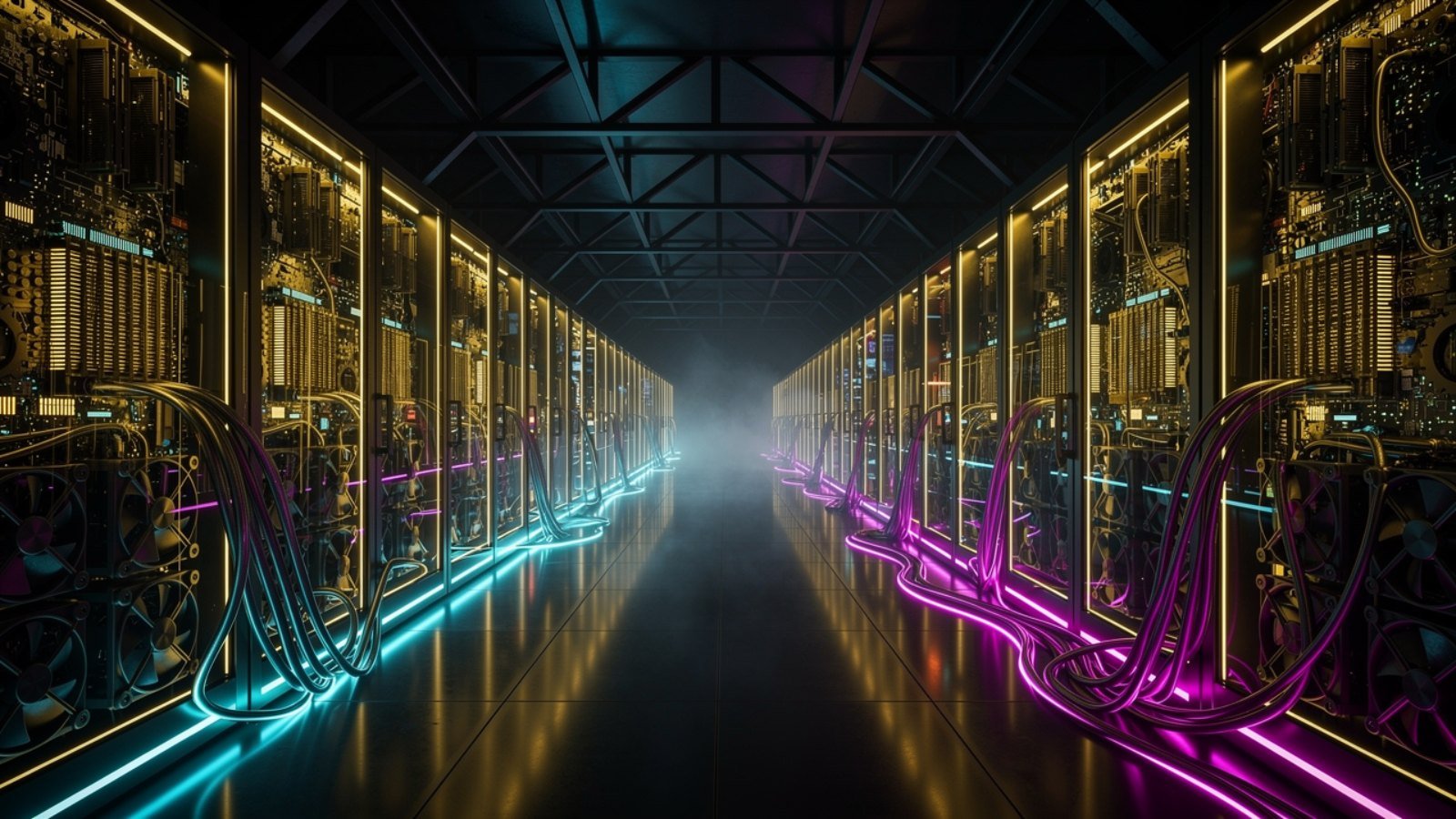
Stargate facilities are not conventional data centers. They are designed from the ground up for AI workloads, which differ from ordinary cloud computing in a critical way: AI training and inference are almost entirely GPU-bound. A single large-scale AI training run can consume tens of thousands of high-end GPUs running simultaneously for weeks or months. That kind of workload requires fundamentally different power density, cooling, and networking than a typical web-hosting facility.
The power demands are extraordinary. Some individual Stargate campuses are expected to draw one gigawatt or more at peak load — comparable to the power consumption of a mid-sized city. Securing grid access, building dedicated substations, and in some cases contracting directly with power producers has become one of the defining logistical challenges of the project. Some sites are exploring co-location with natural gas generation or dedicated renewable capacity to reduce dependence on existing grid infrastructure.
Cooling is the other major engineering challenge. Modern AI data centers typically use evaporative cooling to manage chip temperatures, which requires large volumes of water. Stargate has faced scrutiny on this front, particularly in West Texas where water scarcity is a real concern. Some campuses are piloting dry-cooling and closed-loop alternatives, though these approaches carry their own trade-offs at gigawatt scale.
On the compute side, the campuses are engineered around NVIDIA’s NVLink interconnect fabric, which allows thousands of GPUs to communicate at extremely high bandwidth. This is a prerequisite for training models at the parameter scales that frontier AI labs are targeting in the coming years — models far larger than what current infrastructure can handle.
Why Does This Matter for the Global AI Race?
The competition for AI leadership is, at its foundation, a competition for computing infrastructure. A country or company with more powerful training clusters can develop more capable models faster, iterate more quickly, and — depending on how these capabilities develop — gain significant advantages in science, defence, economic productivity, and technology exports.
China has been building its own AI infrastructure aggressively, though US export controls on advanced semiconductors have constrained its access to the most capable chips. Project Stargate is partly a strategic bet that maintaining a domestic lead in AI compute — built on the most advanced chips produced in the US and its allied chip-fabrication partners — gives the US a durable advantage even as algorithmic development becomes more globally distributed.
It also matters commercially. OpenAI’s ability to train the next generation of models, scale ChatGPT to its hundreds of millions of users, and develop new AI products depends directly on having access to this kind of infrastructure. Without it, compute becomes the ceiling on what is possible, and that ceiling arrives quickly in modern AI development. The same logic applies to every AI company that depends on cloud inference capacity: the underlying infrastructure is the foundation everything else is built on.
Concerns, Criticism and Open Questions
Project Stargate has attracted meaningful criticism from several directions. The most prominent early challenge came from Elon Musk, who publicly claimed — without presenting supporting evidence — that SoftBank lacked the committed capital to back the deal. SoftBank and OpenAI disputed this; construction proceeding on schedule in Abilene was the most direct rebuttal. Musk has his own AI venture (xAI) and a competing infrastructure buildout (the Colossus supercomputer cluster in Memphis), so the competitive context of his comments is relevant.
Substantive critics have focused on environmental impact. The energy demands of multi-gigawatt AI campuses are significant, and there are legitimate questions about whether these facilities are competing for grid capacity that would otherwise serve residential or industrial users. Proponents argue that AI-driven efficiency gains across industries could offset the energy cost many times over — plausible in principle, though unverified at this scale. The water consumption question is harder to deflect, particularly in drought-prone regions.
There are also execution risks. Building 20 major data center campuses in four years is a massive logistical undertaking. Permitting, grid interconnection, construction labour, and chip supply chains all introduce potential delays. And as a joint venture between three large companies with sometimes diverging commercial interests, the governance of Stargate as it matures will be worth watching closely — particularly if AI market conditions shift significantly from what the founders projected in 2025.
Further Reading
If you want to go deeper on the forces driving projects like Stargate, these books offer strong grounding in the economics, geopolitics, and risks of the AI build-out:
- The Coming Wave by Mustafa Suleyman — a co-founder of DeepMind examines why AI and synthetic biology are among the most powerful and difficult-to-contain technologies in human history. See on Amazon → (~$20)
- Power and Progress by Daron Acemoglu and Simon Johnson — two economists argue that AI’s benefits are not inevitable and depend heavily on who controls the infrastructure and the incentives shaping it. See on Amazon → (~$25)
- The Age of AI by Henry Kissinger, Eric Schmidt, and Daniel Huttenlocher — a wide-angle view of how AI is reshaping geopolitics, economics, and human cognition from three writers with very different vantage points. See on Amazon → (~$18)
Frequently Asked Questions
Is Project Stargate the same as the Microsoft–OpenAI partnership?
No. Microsoft has been OpenAI’s primary cloud partner and investor since 2019, and that relationship continues. Project Stargate is a separate joint venture between OpenAI, SoftBank, and Oracle focused specifically on building new AI data center campuses. OpenAI uses both Microsoft Azure infrastructure and the new Stargate facilities, but the Stargate JV operates independently of Microsoft’s own AI infrastructure investments.
Will Project Stargate create jobs in the US?
Yes, though the numbers are debated. The project’s founders cited figures in the range of 100,000 US jobs over the life of the investment, covering construction, data center operations, and regional economic activity. Critics note that data center operations are not particularly labour-intensive relative to the capital invested, so the job creation argument is stronger for the construction phase than for the long term.
How does Project Stargate fit into the AI competition with China?
It’s one of the most significant pieces. US export controls on advanced semiconductors have limited China’s access to cutting-edge chips, but China is building its own infrastructure using domestically developed alternatives. Project Stargate is partly a bet that maintaining a substantial lead in raw compute — built around the most advanced US-made chips — preserves a strategic and commercial advantage. For a broader look at what this competition means for the future of AI, see our guide to what superintelligence is and how close we might be.
The Bottom Line
Project Stargate is the largest private infrastructure investment in AI history. It reflects a genuine belief — among some of the world’s most powerful technology organisations — that the physical layer of AI: the chips, the power, the cooling, the fiber, is going to be as strategically important as the models running on top of it.
Whether the full $500 billion gets deployed, whether the timelines hold, and whether the environmental trade-offs are handled responsibly are all legitimate open questions. What is not in question is the direction: AI is becoming an infrastructure industry, and Project Stargate is the boldest bet yet on what that infrastructure will need to look like.
If you are following the AI industry in 2026, understanding what is being built at the physical layer — and who is building it — is becoming as important as understanding the models themselves.



Leave a Reply